One Cello to Feel Them All: The Quiet Manipulation of Minimalist Film Scores
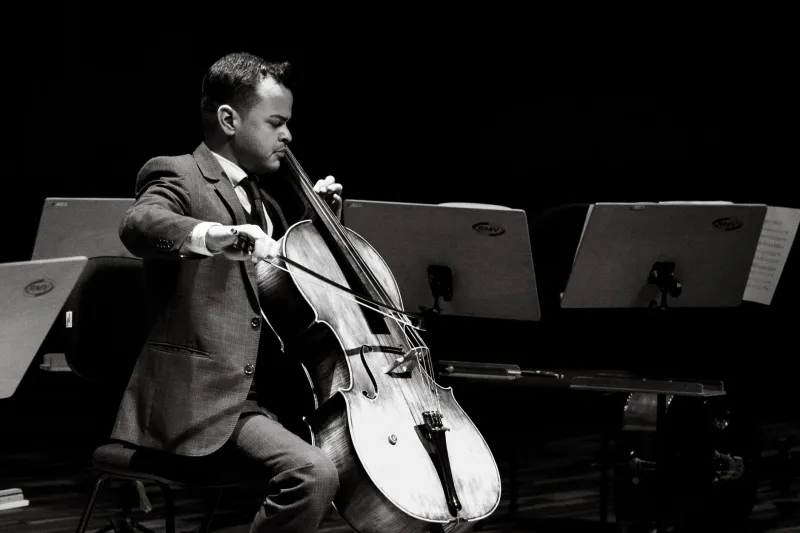
Let's set the scene. A character is sitting at a kitchen table. They are not eating. They are not speaking. The camera has been on their face for approximately forty-five seconds. Nothing has happened. Nothing is about to happen. And yet — softly, almost apologetically — a single cello note blooms from somewhere beneath the silence, joined shortly by a second violin doing its level best to make you feel the weight of human mortality.
You shift in your seat. You feel something tighten in your chest. You think: this is a profound film.
It is not a profound film. It is a film that hired a very good composer.
The Illusion Factory
Minimalist film scoring has become the most reliable trick in prestige cinema's playbook, and at this point it deserves its own exposé. We're not talking about John Williams building a full orchestral cathedral around a shark. We're talking about the specific, surgical deployment of ambient strings — two or three instruments, usually something in the cello-to-viola range, occasionally a lone piano key struck with the emotional energy of someone who just got some very bad news at a doctor's office.
This is not music that tells you what to feel. It's subtler and therefore more dangerous. It creates a climate. A low-pressure emotional weather system that settles over a scene and makes your brain go, "Something important must be happening here, because the music is being very quiet and serious about it."
You've been gaslit by an oboe. Welcome to recovery.
The Three-Minute Face Problem
Here's the test. Watch any given prestige drama — the kind that gets reviewed with phrases like "devastatingly restrained" and "a meditation on grief" — and pick a scene where the score is doing that thing. That thing. The low sustained note, maybe some distant strings, possibly a sound design element that's been tastefully blurred into music so you can't tell where ambient noise ends and emotional manipulation begins.
Now mute it.
Watch the same scene without the score and ask yourself honestly: is this actor communicating something, or are they just existing near a window? Because there is a meaningful difference between a performance that earns silence and a performance that requires a string quartet to explain itself. Minimalist scores, at their most cynical deployment, function as subtitles for scenes that forgot to write any dialogue. They are the movie whispering, "You should feel sad now," while maintaining plausible deniability that it said anything at all.
This is the trick. Volume and bombast are obvious. Nobody walks out of an action movie and says the score moved them. But quiet? Quiet feels earned. Quiet feels like the film trusts you. Quiet, accompanied by two cellos and a composer who studied at somewhere European-sounding, feels like art.
A Brief History of Weaponized Restraint
The minimalist score as emotional shorthand didn't come from nowhere. You can trace a reasonable line from Ennio Morricone's more spare work through the spare, aching compositions of composers like Jóhann Jóhannsson and Ólafur Arnalds, all the way to the current industrial ecosystem in which every A24 film arrives pre-loaded with an original score that sounds like someone discovered loneliness for the first time and decided to process it through GarageBand.
The thing is, when it works, it genuinely works. There are scenes in cinema where the music and the image achieve something that neither could manage alone — where the restraint is a creative choice, not a cover story. The problem is that Hollywood, once it identifies something that makes audiences cry without requiring expensive special effects or a coherent third act, does not exercise restraint about its restraint. It scales it. It franchises it. It puts the sad cello in the trailer so you cry in the theater before the movie has even technically started.
Now every film about a white woman processing something in a rural European location has the same score. Every drama about a man who is bad at talking about his feelings has the same score. They are not the same score legally. But spiritually, emotionally, and functionally? Same cello. Different tax forms.
What We're Actually Responding To
Here's the uncomfortable part, and the reason this particular manipulation is so hard to shake even once you've identified it: it works on a biological level. Minor keys, slow tempos, and certain frequency ranges in string instruments trigger genuine physiological responses in human beings. Your body doesn't know it's being played. It just responds. The hair stands up. The throat tightens. The eyes do the thing.
Filmmakers know this. Composers know this. The entire machine knows this. The question isn't whether the music makes you feel something — it does, reliably, every time — the question is whether you're feeling something about the film or just something about the frequency of a cello string in a specific register.
This distinction matters. Not in a life-or-death way. But in a you've been recommending this movie to people as a profound emotional experience when it was actually just a well-scored slideshow kind of way.
Your Homework
The road to recovery from minimalist score dependency is not complicated, but it does require some active participation on your part.
Step one: next time a quiet scene in a prestige film makes you feel something, pause. Note what the score is doing. Note whether the performance, the writing, or the direction would still be communicating that same thing without it.
Step two: acknowledge, without shame, that sometimes the answer is no. Sometimes the music carried the whole scene and the scene itself was a man looking at a photograph for ninety seconds. This is allowed. Films are allowed to use music. You are allowed to enjoy being manipulated by a cello. This is not a crime.
Step three: just stop calling it profound. Call it what it is — effective. Efficient. A well-executed emotional delivery mechanism. Reserve "profound" for the films where the silence actually came from somewhere, where the restraint was a choice rather than a budget, where the story earned the quiet instead of renting it by the scene from a composer with a very tasteful SoundCloud.
The cello will keep playing. It will keep working. You will keep feeling things in darkened theaters that you did not entirely consent to feeling. That's fine. That's cinema.
Just know who's doing the feeling, and who's doing the billing.