Congratulations, Your Hero Is Eating Sad Noodles Again: The Joyless Meal as Cinema's Laziest Emotional Shortcut
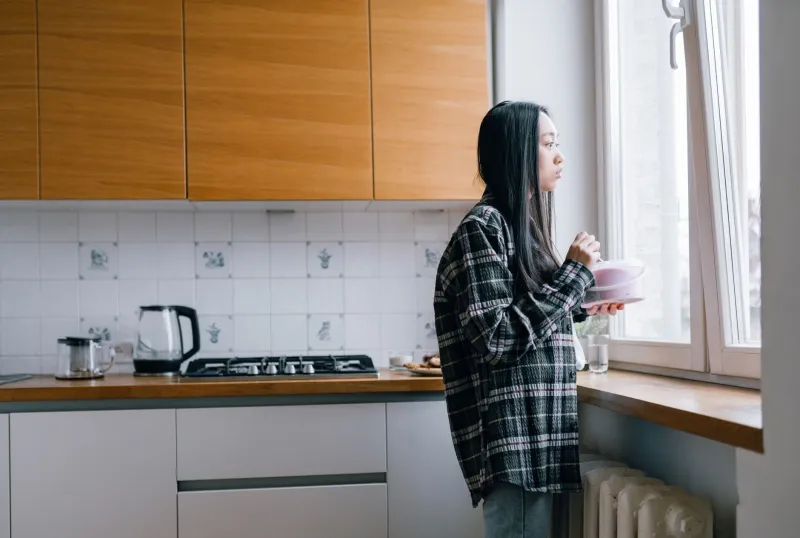
There is a scene in approximately every serious film made since 2004 where the main character sits down at a table — or a counter, or a couch, or sometimes just a floor — and eats something quietly terrible by themselves. No music, or maybe just a little music. A window nearby. Takeout containers. Maybe a fork that gets put down halfway through because the character has feelings and feelings make you lose your appetite, apparently.
The camera holds. You wait. Nothing happens. A critic somewhere writes the word "devastating."
Welcome to the Sad Desk Lunch Cinematic Universe, population: every film that has ever wanted an Oscar and wasn't quite sure how to ask for one.
The Taxonomy of Cinematic Sad Eating
First, let's be precise, because this phenomenon has subcategories and they all deserve to be identified and prosecuted accordingly.
There is the Classic Takeout Tragedy, in which a character sits in a dim apartment eating pad thai directly from the container while staring at either a phone screen or a wall. This communicates that they are modern, isolated, and emotionally unavailable — not just to other characters, but frankly to the audience as well.
There is the Cereal at 2 AM, which signals a different kind of despair: one that is somehow both mundane and operatic. Nobody eats cereal at 2 AM in a movie because they're hungry. They eat cereal at 2 AM because a screenwriter needed a visual metaphor for arrested development and the prop department already had a box of Cheerios.
And then there is the Fancy Restaurant, Eating Alone, which is the nuclear option. This version tells you that the character has money and sadness, which Hollywood has always considered the most respectable combination.
All three accomplish the same thing: replacing actual character development with the visual grammar of loneliness, and trusting that you'll fill in the rest.
How We Got Here: A Brief, Grim History
This didn't start maliciously. Somewhere in the arthouse tradition — your Bergmans, your Antonionis, your films that played at one theater in Manhattan to an audience of seventeen people who all wore scarves indoors — the solitary meal was a genuine compositional choice. Silence as language. Stillness as subtext. A character eating alone because the director had something specific and considered to say about modern alienation.
Then somebody won an award. And then somebody else copied the shot. And now we are here, watching a character in a mid-budget drama about a conflicted architect push a sad burrito bowl around a takeout container while a violin does something ominous in the background, and we are supposed to feel the weight of the human condition.
The arthouse invented the vocabulary. Awards season industrialized it. Streaming scaled it to an almost incomprehensible volume. At this point, if a Netflix original drama does not contain at least one scene of its lead character eating something beige and forgettable while looking out a rain-streaked window, it gets flagged internally as "too cheerful" and sent back for reshoots.
The Calorie Count of Suffering
What makes the Sad Meal scene particularly resilient as a cinematic trope is how efficiently it does absolutely nothing while appearing to do everything.
Consider what a filmmaker is actually communicating: this person eats alone. That's it. That is the entire content of the scene. And yet, surrounded by the right cinematography and a score that sounds like a cello having a panic attack, it gets reviewed as "a quietly shattering portrait of disconnection."
The honest translation of most sad eating scenes is: "We needed to show you the character is lonely but we ran out of budget for the scene where they actually talk to someone and it goes badly."
The joyless meal is, at its core, a placeholder. It occupies runtime. It signals emotional register without requiring dialogue, conflict, or any of the other things that are harder to film and easier to get wrong. It is the cinematic equivalent of writing "[INSERT FEELINGS HERE]" in a script and then hiring a very good cinematographer to make it look intentional.
The Actors Who Have Suffered Through This
Spare a thought for the working actors who have had to eat cold, sad, prop-department food in service of someone else's thematic ambitions.
These are professionals. They trained. Some of them went to Juilliard. They memorized Chekhov in a room with bad lighting and paid their dues in regional theater productions of things nobody came to see. And the role that got them their first awards buzz was one where they slowly ate a sad sandwich while a camera watched them do it for forty-five seconds.
The Academy has never given out an award specifically for Sustained Joyless Chewing, but if it did, the category would be brutally competitive.
A Modest Proposal for the Filmmakers Still Doing This
Here is a radical suggestion: let your character enjoy a meal.
Not in a quirky, character-building way where they eat something weird to show they're unconventional. Not in a rom-com way where eating is a meet-cute device. Just — let someone in your serious, important, emotionally rigorous film sit down and eat something that they appear to find reasonably acceptable, in the company of another human being, without the camera treating it as a funeral.
If your film cannot survive a single scene in which a character eats a burger and doesn't look like they're processing a recent bereavement, your film may have a structural problem that no amount of takeout container cinematography is going to fix.
Depth is not the same thing as sadness. Authenticity is not the same thing as joylessness. A character who experiences small, ordinary pleasures — including a meal that is actually fine — is not less complex than one who stares at cold lo mein like it personally wronged them.
In Conclusion: The Noodles Did Nothing Wrong
The Sad Desk Lunch Cinematic Universe will continue to expand. There are too many prestige dramas in development, too many streaming platforms that need content that feels important, and too many cinematographers who have mastered the art of making a Styrofoam container look like a Hopper painting for this trend to die quietly.
But at least now you can name it. You can sit in your own home, watching your own streaming platform, eating your own perfectly adequate dinner, and when the protagonist of whatever Important Film you've selected sits down alone with their sad bowl of something beige, you can nod knowingly and say: there it is.
The shortcut. The placeholder. The forty-five seconds of chewing that a critic will call "devastating" and a director will call "necessary" and that you, a functioning human adult, will recognize as a scene in which nothing happened and a violin made it sound like something did.
You survived it. Treat yourself to a real meal. One you're allowed to enjoy.