The Orchestra Is Crying and You're Not Even Sad Yet: How Film Scores Learned to Do Your Feelings for You
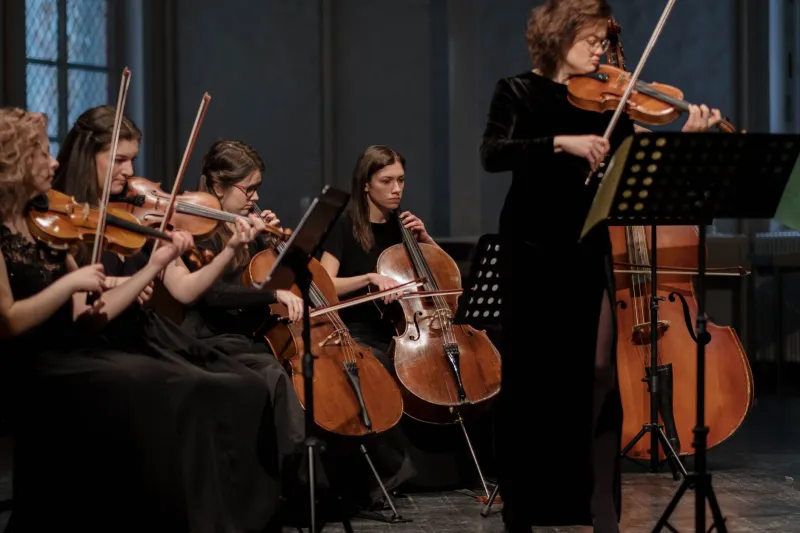
Let's establish something uncomfortable right out of the gate: you have almost certainly cried at a movie scene that, if played in total silence, would have made you feel absolutely nothing. Not a twinge. Not a throat-tightening. Nothing. A man stared at a photograph. A woman walked slowly through a field. Someone held a coffee cup with both hands like it owed them money. And yet — because a composer decided to deploy a solo violin over a bed of low strings and a barely audible choir — you were dabbing your eyes and reconsidering your entire relationship with your father.
This is not your fault. This is a crime that has been committed against you, repeatedly, by an industry that figured out decades ago that music is the fastest route from the screen to your nervous system, and has been exploiting that fact with increasing aggression ever since.
Welcome to your intervention.
The Violin Has Always Been Suspicious
The string section has been emotionally manipulative since before cinema existed. Composers knew this. Audiences vaguely sensed it. But the implicit agreement used to be that the music would show up to support a genuinely affecting moment — to give weight to something that had already earned its emotional payload through writing, performance, or both.
At some point, probably sometime in the late nineties when studios noticed that a mediocre scene with a Hans Zimmer cue was testing better than a good scene with ambient sound, the arrangement changed. The music stopped being the support structure and became the whole building. The scene exists now primarily as a delivery vehicle for the score. The score is the product. You are the target.
The violin didn't start the arms race, but it is absolutely winning it.
How to Identify When You're Being Played
There is a reliable diagnostic test for emotional manipulation via orchestration, and it requires only a small act of imagination. Ask yourself: if this scene had no music, would I feel anything?
Not "would it be less moving" — that's a different question, and yes, obviously silence is less manipulative than a sixty-piece orchestra. The real question is whether the scene has done any emotional work on its own terms. Has the writing built toward this moment? Has the actor given you something to hold onto? Is there a reason, rooted in story and character, that this moment should land?
If the honest answer is "no, but the oboe came in and I lost it," congratulations. You've been scored.
The tells are usually pretty obvious once you know what you're looking for. Watch for the moment the dialogue stops and the music gets louder — not to underscore what was just said, but to paper over the fact that nothing particularly meaningful was just said. Watch for the slow zoom on a face, accompanied by a single sustained note that then blossoms into full orchestration as the camera holds. Watch for the key change. The key change is always a red flag. The key change is the composer grabbing you by the collar and saying feel something right now or I will escalate.
The Arms Race Nobody Asked For
The truly wild thing is how the escalation has worked. A generation ago, a sad piano was enough. Then the sad piano needed strings. Then the strings needed a choir. Then the choir needed to be a children's choir, because apparently adult voices don't trigger the same primal response and someone in a focus group somewhere confirmed this. Now we have film scores that sound less like music and more like a full sensory assault designed by engineers who were given the brief: make them cry within ninety seconds or the scene gets cut.
Marvel, to its credit or discredit depending on your patience, basically industrialized this process. Every emotional beat in the MCU arrives with a score that tells you exactly how to feel about it, in case the preceding two hours of plot logistics didn't leave you with enough context to generate genuine feeling on your own. The music is there to simulate depth. To create the sensation of meaning in scenes that are primarily concerned with setting up the next film.
But Marvel is just the most visible offender. Prestige dramas do it too, just with better instruments and a slower tempo. The indie circuit does it with acoustic guitar and a lot of reverb. The difference is aesthetic, not ethical.
What a Score Is Actually Supposed to Do
This is not an argument against film music. That would be insane. Some of the most genuinely effective emotional experiences in cinema are inseparable from their scores — Schindler's List, The Social Network, There Will Be Blood, Arrival. Music that works in concert with story and character can amplify something real into something transcendent.
The distinction is between amplification and fabrication. A good score finds the emotion that is already present in a scene and makes it resonate more deeply. A manipulative score manufactures the sensation of emotion in a scene that hasn't done the foundational work. One is a collaboration. The other is a con.
You can usually tell the difference by what happens when the music stops. In genuinely affecting scenes, the silence after the score drops still carries weight. In manufactured ones, the feeling evaporates almost immediately — because it was never yours to begin with. The orchestra borrowed it to you for the duration of the cue, and when the cue ended, they took it back.
Your Recovery Plan
The good news is that awareness is most of the battle. Once you've identified the mechanism, you can start making choices about when to let it work on you and when to hold your ground.
Start muting the TV during emotionally loaded scenes. Not forever — this is a diagnostic exercise, not a lifestyle. Just for thirty seconds, to see what the scene is actually doing without its musical crutch. You will sometimes discover that the scene is genuinely powerful, that the actor is doing something extraordinary, and that you were right to feel what you felt. You will other times discover that a man is simply walking through an airport to a swelling string arrangement and that, in silence, he is just a man in an airport.
Both discoveries are useful. One confirms that your instincts are sound. The other confirms that you have been emotionally pick-pocketed by a composer with a sixty-piece orchestra and a very specific brief.
Either way, you get to keep your reaction. You just get to know where it actually came from.
The sad violin knows your secrets. It also knows exactly which frequency to play them back at. The least you can do is know that it knows.